Corrosion is one of the leading causes of asset deterioration in the oil and gas industry, resulting in costly repairs, production downtime, environmental risks, and safety concerns. Cathodic Protection (CP) is a proven electrochemical technique used to prevent corrosion and extend the service life of metallic structures.
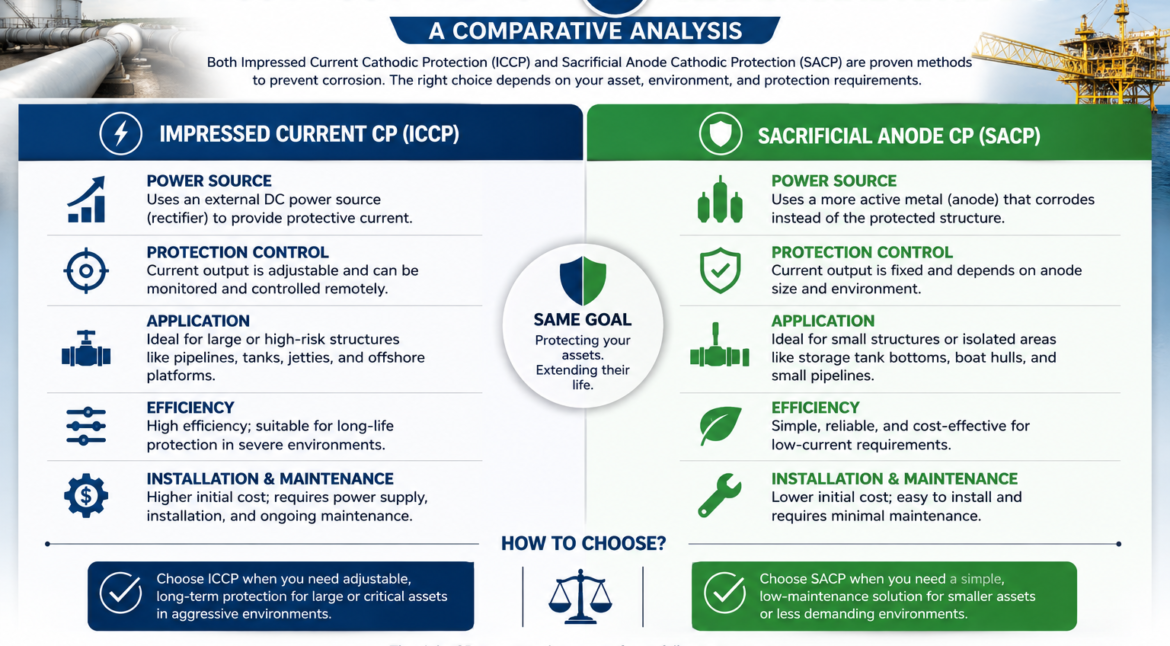
The two primary cathodic protection methods are Impressed Current Cathodic Protection (ICCP) and Sacrificial Anode Cathodic Protection (SACP). While both systems serve the same purpose—protecting steel structures from corrosion—they differ significantly in design, operation, cost, and suitable applications.
This document compares the two systems to help engineers, facility owners, and project managers choose the right solution for their assets.
Understanding Cathodic Protection
Cathodic protection prevents corrosion by making the metal structure the cathode of an electrochemical cell. This is achieved either by attaching a more reactive metal that corrodes instead of the structure or by supplying direct current from an external power source.
Both methods are widely used across pipelines, storage tanks, marine structures, offshore platforms, refineries, petrochemical plants, and water infrastructure.
What is Sacrificial Anode Cathodic Protection (SACP)?
Sacrificial Anode Cathodic Protection protects steel by connecting it to a more electrochemically active metal known as a sacrificial anode.
Common sacrificial anode materials include:
- Magnesium
- Zinc
- Aluminum
These anodes gradually corrode, sacrificing themselves to protect the steel structure.
Typical Applications
- Underground storage tanks
- Residential gas pipelines
- Water pipelines
- Ship hulls
- Marine Steel structures
- Buried pipelines
Advantages
- No external power source required
- Simple installation
- Low maintenance
- Reliable in remote locations
- Lower initial investment for small assets
- Limitations
- Limited current output
- Anodes require periodic replacement
- Less suitable for large structures
- Performance depends on soil or water conditions
What is Impressed Current Cathodic Protection (ICCP)?
Impressed Current Cathodic Protection uses an external direct current (DC) power source, typically a transformer rectifier or switch mode power supply, to deliver protective current through inert or long-life anodes.
Unlike sacrificial systems, the anodes do not provide protective current through their own corrosion. Instead, the external power source controls the level of protection delivered to the structure.
Typical Applications
- Long-distance transmission pipelines
- Tank farms
- Refineries
- Petrochemical plants
- Offshore platforms
- Marine terminals
- Jetties
- Large industrial facilities
Advantages
- Suitable for very large structures
- Adjustable current output
- Longer anode service life
- Can protect poorly coated structures
- Supports remote monitoring and control
- Lower lifecycle cost for large installations
Limitations
- Requires electrical power
- Higher initial installation cost
- More complex design and commissioning
- Requires periodic inspection and maintenance
Side-by-Side Comparison
| Feature | Sacrificial Anode (SACP) | Impressed Current (ICCP) |
| Power Source | None | External DC Power Supply |
| Current Output | Limited | Adjustable |
| Best for | Small structures | Large structures |
| Initial Cost | Lower | Higher |
| Operating Cost | Moderate (anode replacement) | Lower over long-term for large assets |
| Maintenance | Low | Moderate |
| Monitoring | Limited | Advanced remote monitoring available |
| Design Complexity | Simple | More sophisticated |
| Asset Size | Small to medium | Medium to very large |
Which System Lasts Longer?
The lifespan of a cathodic protection system depends on design, operating conditions, coating quality, and maintenance.
Sacrificial anodes are consumed over time and must be replaced periodically.
ICCP systems use durable anodes designed for long service lives, often exceeding 20 years when properly maintained. Because the protective current is externally controlled, the system can be adjusted as asset conditions change.
Which System is More Cost-Effective?
For smaller installations, sacrificial anode systems are often the most economical solution because they are simple to install and do not require electrical power.
For larger facilities such as tank farms, transmission pipelines, offshore platforms, and refineries, ICCP systems generally provide better long-term value due to their ability to protect extensive structures efficiently and their lower lifecycle cost.
A proper engineering evaluation should consider:
- Asset size
- Environmental conditions
- Coating quality
- Design life
- Maintenance strategy
- Power availability
- Total cost of ownership
Factors to Consider When Choosing a Cathodic Protection System
- Structure dimensions
- Soil resistivity or seawater conductivity
- Operating environment
- Coating condition
- Current demand
- Accessibility for maintenance
- Expected service life
- Regulatory and industry standards
- Future expansion requirements
Each project should be designed based on detailed technical assessments rather than a one-size-fits-all approach.
Can Both Systems Be Used Together?
Yes. In some facilities, both sacrificial anode and impressed current systems are used to protect different assets or sections of the same installation.
For example:
A refinery may use ICCP to protect large storage tanks and buried pipelines.
Smaller equipment, marine fittings, or isolated structures may be protected using sacrificial anodes.
This hybrid approach allows operators to optimize performance and cost across the facility.
Choosing the Right Partner
The effectiveness of any cathodic protection system depends on proper engineering design, quality components, correct installation, and ongoing monitoring.
Mountleigh Oil & Energy Ltd. provides engineering procurement solutions for corrosion control through its strategic partnership with CPCL. We supply transformer rectifiers, anodes, reference electrodes, junction boxes, remote monitoring systems, and other cathodic protection materials for oil and gas, marine, power, and industrial applications across Nigeria.
Neither Impressed Current Cathodic Protection nor Sacrificial Anode Cathodic Protection is universally “better.” The ideal solution depends on the size of the asset, operating environment, current requirements, maintenance strategy, and project objectives.
Sacrificial anode systems are ideal for smaller assets where simplicity and independence from external power are priorities. Impressed current systems are the preferred choice for protecting large, complex, or high-value infrastructure that requires adjustable current output and long-term performance.
A professional engineering assessment is the best way to determine the most effective cathodic protection solution for your facility.
Frequently Asked Questions
What is the main difference between ICCP and SACP?
ICCP uses an external DC power source to supply protective current, while SACP relies on the natural corrosion of sacrificial anodes to protect the structure.
Which system is better for pipelines?
Long-distance transmission pipelines typically use ICCP, while shorter or isolated pipelines may be effectively protected with sacrificial anodes, depending on the design requirements.
Do sacrificial anodes need replacement?
Yes. Because they gradually corrode while protecting the structure, sacrificial anodes must be inspected and replaced at intervals determined by the system design and operating conditions.
Can ICCP systems be monitored remotely?
Yes. Modern ICCP systems can be integrated with remote monitoring technology, enabling operators to monitor performance, receive alarms, and optimize maintenance without frequent site visits.
How do I choose the right cathodic protection system?
The best solution depends on factors such as asset size, coating quality, environment, power availability, design life, and maintenance objectives. A detailed engineering assessment is recommended before selecting a system.